
Last updated September 20, 2026
Free on-site gate assessment - hinges, posts, and your LiftMaster or Nice gate operator checked before anything is quoted
The assessment is free and the quote is the invoice.


 Before
 After
After Before
 After
After Before
 After
AfterGate Repair Warning Signs: A Miami Gardens Homeowner’s Reference Guide
A gate that hesitates for two seconds before moving is not “getting slower.” It’s a control board logging a fault it hasn’t yet tripped. Most gate failures in Miami Gardens announce themselves weeks before the gate actually stops working, but the early signals are easy to misread as quirks, weather, or age. This reference maps each observable symptom to the failure chain behind it, so you know which signs justify watching and waiting, which justify a same-week service call, and which mean the gate should be taken out of service until a technician arrives. We’ve sorted every warning sign into an urgency tier and explained what a technician will look for when they open the control box.
Quick Answer
The most common gate repair warning signs in Miami Gardens are hesitation before movement, grinding or squealing during travel, partial opening or closing, refusing to close, and reversed travel. Hesitation of more than two seconds, any grinding noise, or a gate that reverses without an obstruction are structural or electrical precursors, not cosmetic quirks. If your gate makes noise it didn’t make six months ago or moves differently than it did last month, photograph it or video it and call a gate technician for a written diagnosis.
Table of Contents
- Symptom-to-Failure Chain: What the Gate Is Telling You
- Worn Actuator vs. Failing Control Board: Same Symptom, Different Repair
- South Florida Warning Signs: Salt, UV, and Waterlogged Wiring
- Urgency Tiers: Monitor, Schedule, or Stop Using the Gate
- How to Document a Warning Sign with Your Phone
- Warning Sign Patterns on Common Gate Motor Brands
- Common Mistakes to Avoid
- When to Call a Professional
- Frequently Asked Questions
- The Bottom Line
 Before
 After
AfterSymptom-to-Failure Chain: What the Gate Is Telling You
Every observable gate behavior is the end of a chain that starts somewhere specific: a limit switch, a capacitor, a gear, a wire connector, a control board. The behavior you see is the last link. What matters is the link before it. Here’s the map.
Hesitation Before Movement (2 Seconds or Longer)
The motor receives voltage, but the control board delays the command. In Miami Gardens, we most often trace this to a capacitor losing its charge capacity. A capacitor is the component that stores the surge of energy needed to start the motor turning. When it degrades, the board first asks the capacitor to perform, the capacitor can’t deliver, and the board retries. That retry loop is the hesitation you see. If the board retries long enough, it logs a fault and refuses to move the gate at all.
What it means: The capacitor is near end of life, or a limit switch is out of position and the board is hunting for a reference point. Both are same-week fixes in most cases. The part cost on the capacitor is low; the labor is in opening the box and testing.
Grinding, Squealing, or Scraping During Travel
Metal-on-metal sound means a mechanical component is wearing against another surface. On a sliding gate, it’s usually the drive gear losing teeth against the rack, or the rollers underneath the gate grinding on worn bearings. On a swing gate, it’s frequently the arm bracket at the hinge point or the actuator’s internal screw eating itself. The sound is the failure happening in real time. A gate that grinds for a week will still open, until the day the gear tooth shears and the motor spins without moving the gate at all.
What it means: Same-week call. The fix is almost always cheaper before the part fails completely, because a failed gear often damages the part it mates with.
Partial Travel: Gate Opens Halfway or Stops Short
The gate starts, moves, then stops as if it hit an obstacle that isn’t there. This is the control board reacting to a limit switch reading it doesn’t expect. Limit switches are the mechanical or magnetic sensors that tell the board where the gate is in its travel. When a limit switch drifts out of position, the board thinks the gate has reached the end of travel before it actually has. We have documented limit switches set 12 degrees past their true travel, which creates exactly this partial-open behavior.
What it means: Limit switch adjustment or replacement. On a sliding gate, this can also be a broken magnet on the travel rail. Schedule it. If the gate is leaving a gap large enough for a person to slip through, treat it as urgent because the property’s access point is now uncontrolled.
Refusing to Close Completely
The gate opens fine but stops a few inches or a full foot short of closed, or reverses before seating. The most common cause across Miami Gardens is a photo-eye misalignment. A photo-eye is the infrared beam that stops the gate if something crosses the path. When the beam is interrupted by a misaligned sensor, a dirty lens, or a vine that grew across the beam path, the board interprets it as an obstruction and refuses to close. It’s not a broken board. It’s a safety system doing its job on bad information.
What it means: Clean and realign the photo-eye. If that doesn’t resolve it, the photo-eye itself may be failing. South Florida UV degrades the plastic lens over time, scattering the beam. A new photo-eye pair runs roughly $80 to $160 for the part, plus the service call.
Reversing Mid-Travel Without an Obstruction
The gate closes, then reverses as if it hit something. This is the board reading an amperage spike: the motor is drawing more current than the board’s safety threshold allows, so the board treats it as an obstruction and reverses. The spike comes from mechanical resistance, not an actual obstruction. Worn rollers, a rack out of alignment, hinge pins binding from salt corrosion, a gate that’s physically dragging on the driveway because the post has settled. The board is doing what it’s programmed to do. The problem is upstream.
What it means: A physical inspection of the gate’s mechanical path. If hinges are binding, it’s a lubrication and realignment job. If the gate is dragging, it may need a post reset or wheel replacement. Schedule it before the repeated resistance trips kill the control board’s motor driver, which turns a $200 fix into an $800 control board replacement.
Phantom Movement: Gate Opens or Closes on Its Own
The gate moves with no keypad entry, no remote press, no exit loop trigger. This is almost always a short in the low-voltage wiring, frequently from water intrusion in an underground conduit or a remote receiver picking up stray RF interference. In Miami Gardens, the water table is high and underground conduit joints fail, fill with water, and create intermittent shorts that look, to the control board, like a command signal. The gate opens because the board saw voltage on the open circuit terminal.
What it means: Stop using the automatic function and call same-day. A gate that operates on its own is a safety hazard and a security breach. The technician will test continuity on the control loop wiring and likely run a new direct-burial rated cable if the conduit is compromised.
Worn Actuator vs. Failing Control Board: Same Symptom, Different Repair
This is the most expensive misdiagnosis in gate repair, and homeowners in Miami Gardens ask about it constantly because the symptom looks identical from outside. A gate that moves slowly, or stutters, or stops mid-travel can be caused by a worn actuator (the mechanical arm or piston that physically moves the gate) or a failing control board. If you replace the actuator when the board was the problem, you’ve spent $400 to $900 and solved nothing. If you replace the board when the actuator was binding, the new board burns out its motor driver within months trying to push a load it was never designed for.
How to Tell the Difference
- Listen for the motor. When the gate moves slowly, is the motor whining or laboring? A laboring motor sound means the board is sending full voltage and the actuator is struggling. That’s mechanical. If the motor sounds normal but the gate moves in jerks or barely moves at all, the board is likely delivering inconsistent voltage. That’s electrical.
- Watch for pattern. Does the slow movement happen every cycle, or intermittently? A consistent, every-time slowness points to a worn actuator losing its mechanical efficiency. An intermittent behavior, worse after rain or on hot afternoons, points to a board component degrading with temperature or moisture.
- Check the fault code. Most modern boards (DoorKing, Linear, Viking) have a diagnostic LED or a small display showing a fault code. A DoorKing board flashing a specific sequence is telling you whether it’s an overload condition (mechanical) or a logic fault (board). Write down the code or video it before you reset anything.
We’ve seen a Miami Gardens homeowner replace a swing arm actuator at $650 when the real failure was a DoorKing control board with a failing relay, a $240 part. The symptom was identical: a gate that opened halfway and stopped. The diagnosis difference was three minutes with a multimeter at the motor terminals. This is why a written diagnosis with voltage readings matters, and why you should ask your technician what they measured before they quote a replacement.
South Florida Warning Signs: Salt, UV, and Waterlogged Wiring
Miami Gardens gate systems fail differently than gates in inland cities. The environment works against every component, and the warning signs are often environmental before they’re mechanical.
Salt Corrosion on Exposed Terminals
Surface salt from coastal air settles on wire terminals, control board connectors, and battery leads. It conducts electricity where it shouldn’t and creates resistance where it should. The first sign is usually an intermittent failure: the gate works most days, then fails after a morning dew or a rain event. Corroded terminals create resistance that drops voltage below the board’s minimum threshold. The board faults, and by the time the technician arrives, the connection has dried and the gate works again. If your gate fails after rain and works when dry, that’s salt corrosion on a terminal, not a ghost.
UV Degradation on Photo-Eye Lenses
South Florida sun breaks down the plastic lens on photo-eyes over three to five years. The lens turns cloudy, the infrared beam scatters, and the board sees a weak signal as an obstruction. The gate refuses to close. Homeowners clean the lens, it works for a week, then fails again. The fix is a new photo-eye pair, not another cleaning. UV-damaged plastic cannot be polished back to optical clarity.
Waterlogged Underground Wiring
Miami Gardens has a high water table, and direct-burial low-voltage cable that wasn’t rated for wet conditions eventually saturates. The symptom is typically phantom gate movement or failed commands after heavy rain. The water creates a partial short that sends voltage to the wrong terminal on the board. The repair is a new cable run, ideally in conduit rated for wet locations. Any technician who installs direct-burial wire in Miami Gardens without wet-rated jacketing is creating a future call.
Failing Batteries on Backup Systems
If your gate uses battery backup, the heat in Miami Gardens shortens battery life. Most backup batteries last 18 to 36 months here, not the five years manufacturers suggest for temperate climates. The warning sign is a gate that works on AC power but fails or moves slowly when the power blinks during a storm. Test the battery annually. A $120 battery replacement is cheaper than discovering the backup is dead during a hurricane outage.
Urgency Tiers: Monitor, Schedule, or Stop Using the Gate
Not every warning sign deserves the same response. We sort them into three tiers.
Tier 1: Monitor and Document
- Occasional hesitation under one second, especially on cold mornings
- A new but faint creak that appears only during the first open of the day
- The gate closes fully but touches the ground stake slightly harder than it used to
- Cosmetic rust on the gate frame that doesn’t affect hinge points or wheels
Action: Video it once a week. If the behavior changes in frequency or severity, move it to Tier 2. If it’s stable for 60 days, mention it at your next scheduled maintenance.
Tier 2: Schedule a Same-Week Service Call
- Grinding or scraping during every travel cycle
- Consistent hesitation of two seconds or longer
- Partial travel that happens more than once in a two-week period
- Photo-eye misalignment that returns after cleaning
- Visible wear on the drive gear or rack teeth
Action: Call a gate technician and schedule. These are precursors that will become Tier 3 failures if left alone. The repair is cheaper now. A failing capacitor is a $40 part and a $150 service call; a burned-out control board is $400 to $900.
Tier 3: Stop Using the Gate and Call Same-Day
- Phantom movement: the gate opens or closes with no command
- Any exposed or sparking wire near the control box
- The gate reverses and opens fully every time, leaving the property unsecured
- A gate that has come off its track or dropped from a hinge pin
- Burning smell from the motor or control box
Action: Disconnect the motor from power if you can do so safely at the breaker, and call a professional immediately. A gate that moves on its own is a safety hazard to people and vehicles. A burning smell means an electrical component is failing and could start a fire.
How to Document a Warning Sign with Your Phone
A 20-second video saves a technician 20 minutes of diagnosis and saves you the cost of a second visit if the problem doesn’t reproduce while we’re on site. Here’s what to capture.
- Stand where the gate motor is visible. We need to see the motor housing, the arm or chain, and the gate’s travel path in the same frame.
- Record the full cycle. Open the gate and film from the moment you press the remote until the gate stops moving. Capture the entire travel, not just the part where the problem happens.
- Narrate what you’re observing. Say out loud what you see: “It hesitated about three seconds before moving, then stopped about a foot short of the post.” Your voice on the video gives the technician a second data point.
- Film the control box. Open the control box if it’s accessible and safe. Record the LED display or diagnostic lights. If a fault code is blinking, keep the camera on it for at least 10 seconds.
- Capture the sound. Move the phone close to the motor during travel. Grinding, clicking, or a hum that’s louder than normal all matter.
- Note the conditions. Say the time of day, whether it just rained, and if the gate has been used heavily that day. Miami Gardens afternoon heat affects electronics differently than a cool morning.
Send the video to your technician before the appointment. Under the Haven Standard we’ve followed since 2014, every visit includes a photo log of what was found, what was set, and what was installed, so the record you keep begins with the record you send.
Warning Sign Patterns on Common Gate Motor Brands
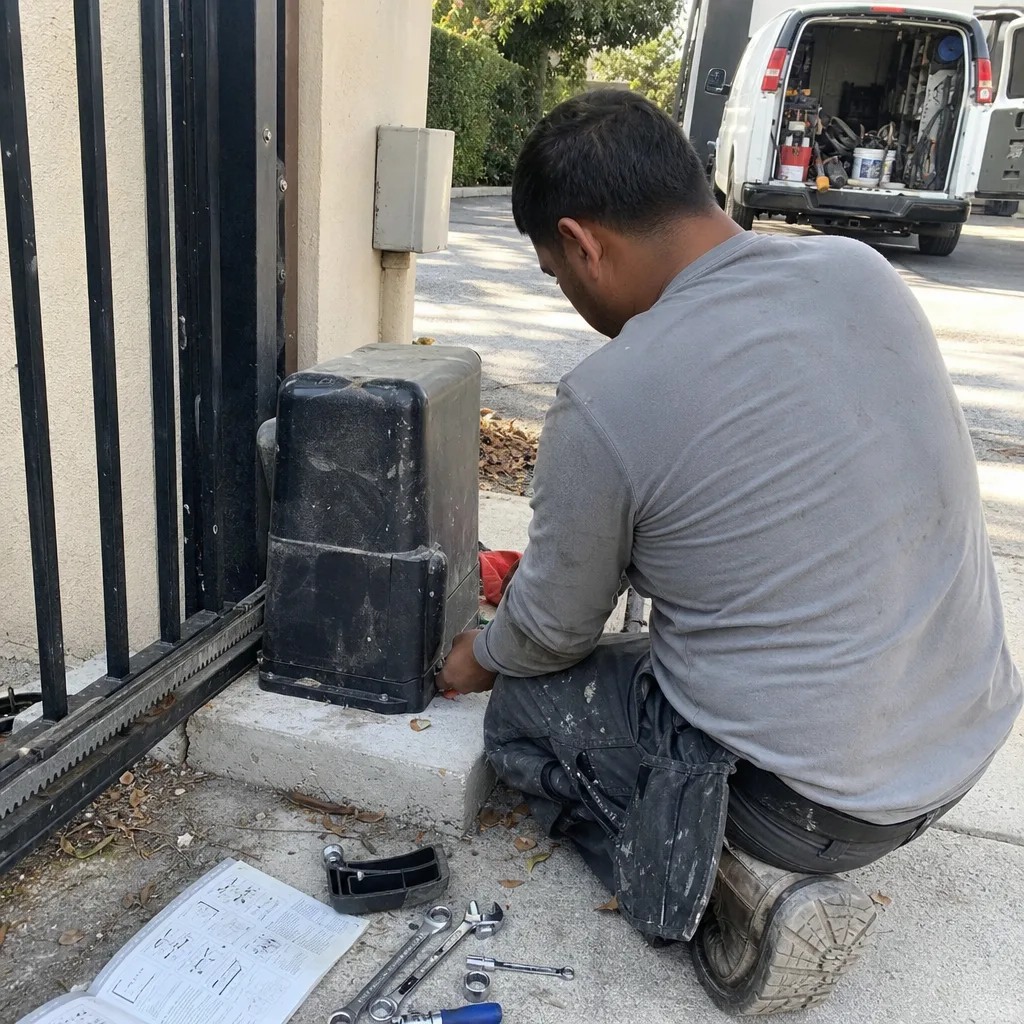
Different motor manufacturers fail in different patterns. Here’s what we see most often across Miami Gardens properties.
DoorKing
DoorKing sliding gate operators are common on Miami Gardens commercial and residential properties. The most frequent warning sign is a gate that creeps backward after stopping, caused by a failing limit switch or a worn clutch. Doorking boards are generally robust, but their diagnostic LEDs are cryptic, and homeowners often reset the board before recording the fault code. Don’t reset. Record first.
Linear
Linear swing gate actuators are widely used on residential gates in Miami Gardens. We most often see capacitor failure, which presents as hesitation before movement and eventually a no-start condition. Linear boards are reliable but sensitive to voltage drops, so a battery or transformer that’s sagging will cause intermittent faults that mimic board failure.
Viking
Viking operators are heavier-duty by design. The warning sign we see most is gear or chain wear from a gate that’s slightly too heavy or a drive track that’s slightly out of alignment. The sound is a rhythmic “click-click” during travel. Early chain slack adjustment is cheap; a snapped chain and damaged sprocket is not.
Ghost Controls
Ghost Controls is a popular retrofit kit. The most common warning sign is the system losing its limit settings after a power interruption, which points to a backup battery that’s dying or a board’s memory capacitor failing. It’s usually a same-day repair once the root cause is identified.
Vance Gate Repair works on all nine major automation brands, so if you’ve inherited a motor from a previous owner and don’t know what brand it is, we can identify it on site. For a deeper look at our gate motor and opener services across Gate Motor & Opener in Miami Gardens, start there.
Common Mistakes to Avoid
- Resetting the control board before recording the fault code. The fault code is the technician’s single best diagnostic tool. Losing it means the problem has to reproduce during the service call, and if it’s intermittent, it won’t. Record first, reset second.
- Lubricating parts that aren’t meant to be lubricated. Grease in the wrong place attracts sand and salt, creating a grinding paste. Chain-driven gates need specific chain lube. Gear-driven gates need none. If you’re unsure, leave it dry.
- Adjusting limit switches without marking the original position. Homeowners trying to fix a partial-open condition often turn the adjustment screw with no reference mark. The gate gets worse, and the technician doesn’t know where it was. Mark first, adjust second, or don’t adjust.
- Ignoring a rain-related intermittent failure. In Miami Gardens, a gate that fails after rain and works when dry is a wiring problem, not a coincidence. It will not dry out and heal.
- Replacing the remote battery to fix a gate that reverses. The remote isn’t the problem. The photo-eye or the obstruction sensor is. A new battery in the remote is wasted money and delayed repair.
- Waiting until the gate fully fails to call. A Tier 2 symptom costs a few hundred dollars to fix. A Tier 3 failure often costs $600 to $1,500 because the failed component took other components with it.
- Assuming the gate needs to be replaced. Most Miami Gardens gate failures are repairable. A company that steers you toward replacement before showing you the failed part and a written repair option is not giving you a diagnosis; they’re giving you a sales pitch.
When to Call a Professional

Call a gate technician when the symptom falls into Tier 2 or Tier 3, when the gate has failed twice in the same way, or when you’ve already tried the obvious fixes and the problem returned. Gates are heavy machines moving under motor power, and the components that fail often carry stored mechanical tension or live electrical voltage. If the gate is off its track, if springs or cables are visibly damaged, or if you see sparking, do not attempt repair. Gate Repair in Miami Gardens covers the full range of what we diagnose and fix. Vance Gate Repair Miami Gardens offers free estimates in Miami Gardens, including a written review of any existing diagnosis from another company. Call (786) 789-0087 and a live person answers, any hour.
Frequently Asked Questions
Most gate repairs in Miami Gardens run between $125 and $450 for a service call with parts and labor, depending on the failure. Capacitor replacement typically costs $180 to $260 total, photo-eye replacement $160 to $280, limit switch adjustment $125 to $200, and control board replacement $400 to $900 depending on the brand and board model. Every price is written and handed to you before any work starts, so the invoice matches the quote. Call (786) 789-0087 for an exact written estimate.
Yes, we dispatch same-day for Tier 3 failures in Miami Gardens, including a gate that won’t close, won’t open, or is moving on its own. A live person answers the phone at (786) 789-0087 24 hours a day and will get a technician scheduled immediately. The price is written before any work begins, and the technician arrives with the name and photo you received in advance.
A full Gate Installation in Miami Gardens includes the gate structure, hinges or track, the actuator or motor, safety photo-eyes, control board, and the low-voltage wiring to power it all. If you’re replacing an existing gate, the estimate also covers removal and disposal of the old structure. The written scope lists every component and part number before installation starts, so there’s no line item on the final invoice you didn’t approve in advance.
Yes, we run the low-voltage power to the gate and install or replace safety edges, which are the pressure-sensitive strips that stop the gate if it contacts something. Safety edges and photo-eyes work together, and both must be functioning for the gate to meet current safety standards. We test both on every repair and installation visit and document the readings in the photo log.
A gate that fails only after rain in Miami Gardens almost always has water intrusion in the low-voltage wiring or a corroded terminal creating resistance when wet. The water table here is high, and buried conduit joints fail over time. The fix is a new wet-rated cable run, often in conduit. Leaving it alone means the intermittent short will eventually damage the control board.
A properly installed gate motor in Miami Gardens typically lasts 8 to 12 years before requiring replacement, but the salt air and high UV exposure shorten that range compared to inland climates. Capacitors and backup batteries fail much sooner, usually at the 2 to 4 year mark. Regular maintenance, including terminal cleaning and battery testing, extends the useful life of the motor itself and catches the cheap failures before they become expensive ones. For a full overview of our motor repair and replacement services, see Gate Motor & Opener in Miami Gardens.
A gate that won’t close fully, opens on its own, or stops short of the post is an access-control failure. The gate exists to control access. If it’s not doing that, the property is exposed regardless of whether you’re home. A gate that grinds but still closes completely is an inconvenience you can schedule around. A gate that leaves a gap or moves without a command is a security failure and should be addressed same-day. For more on how we approach gate repair in Miami Gardens, visit Vance Gate Repair Miami Gardens home.
The Bottom Line
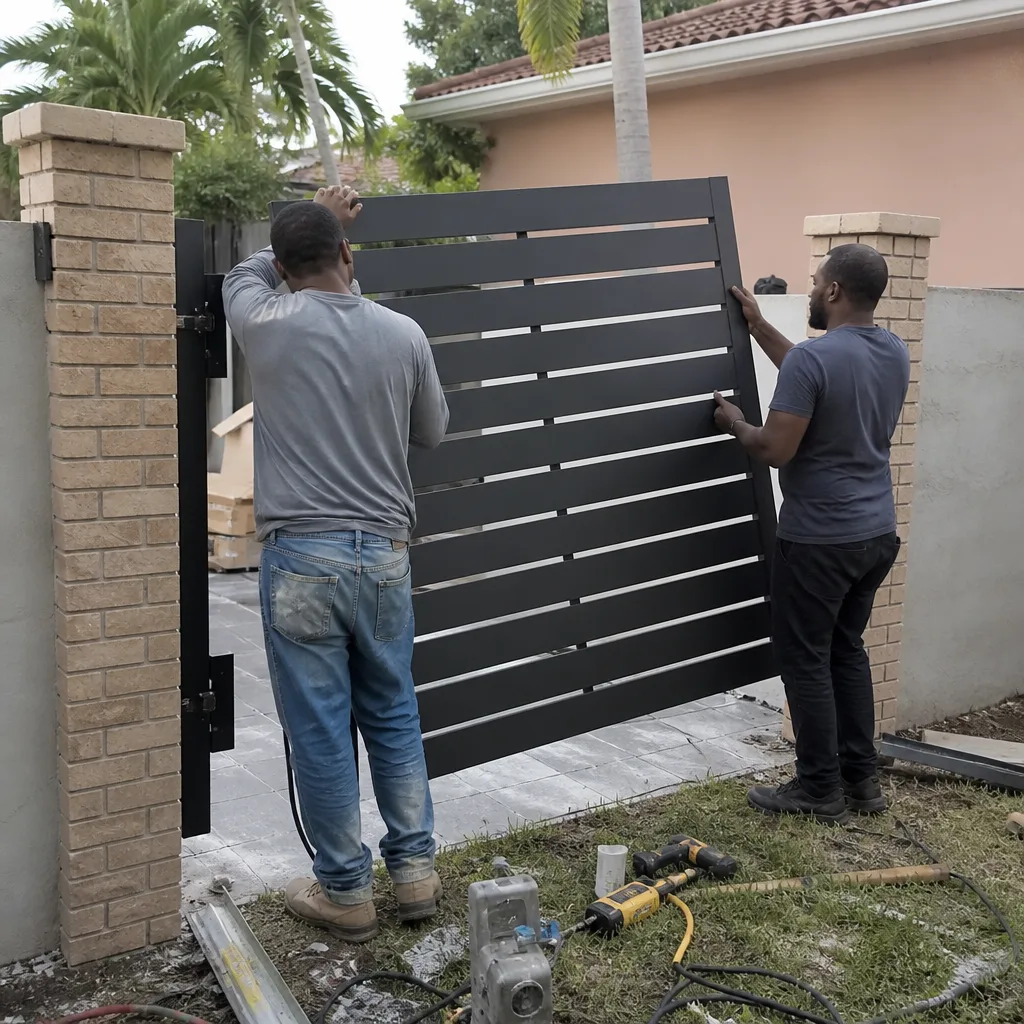
Gate warning signs in Miami Gardens are knowable, documentable, and repairable if you read them early. Hesitation is a capacitor or a limit switch, not a slow gate. Grinding is a gear failing, not a quirk. A gate that fails after rain is a wiring problem, not a coincidence. The difference between a $200 repair and a $900 board replacement is usually a few weeks of ignored symptoms. Video the behavior, note the conditions, and call a technician who will write the price down before touching anything. That’s how a gate repair should work, and it’s how we’ve run Gate Repair in Miami Gardens since 2014.
Written by Adrian Vance, Owner at Vance Gate Repair Miami Gardens, serving Miami Gardens since 2014.