
Last updated September 21, 2026
Free on-site gate assessment - hinges, posts, and your LiftMaster or Nice gate operator checked before anything is quoted
The assessment is free and the quote is the invoice.


 Before
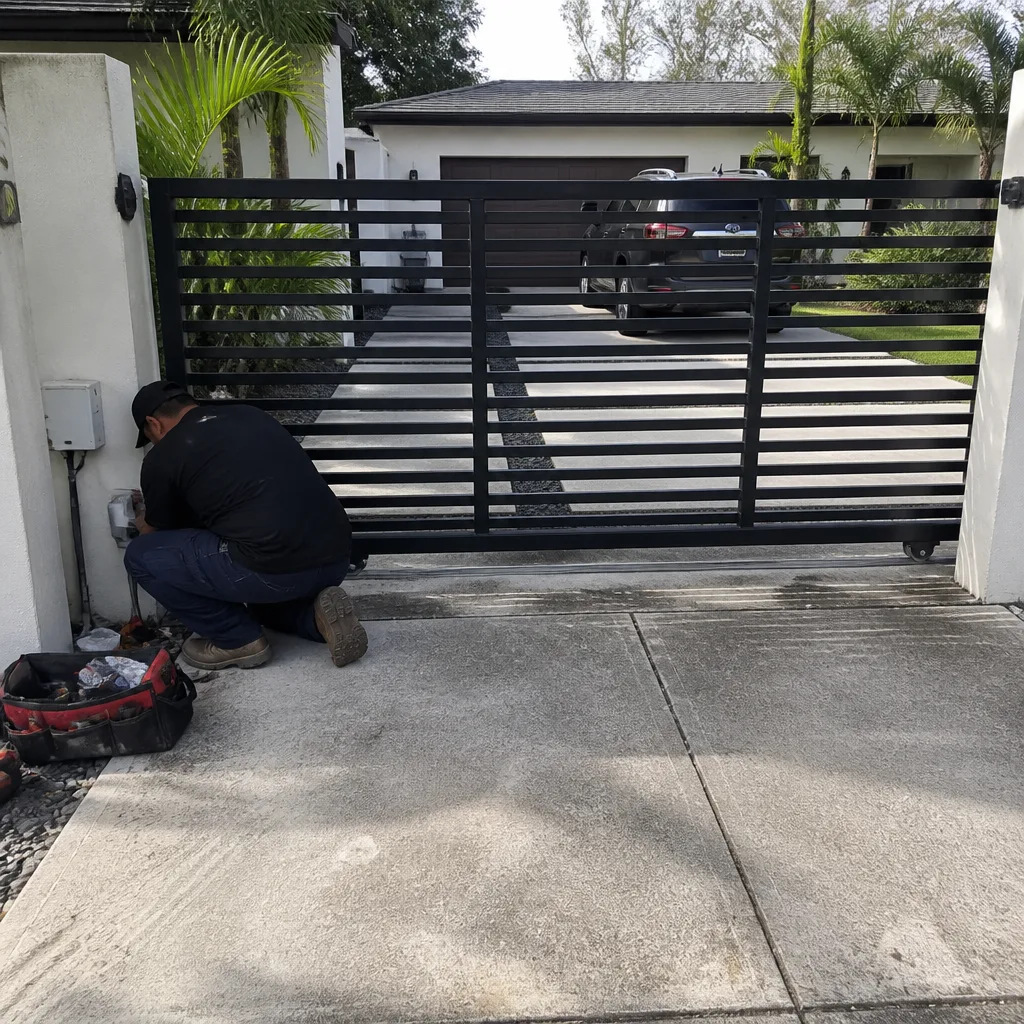 After
After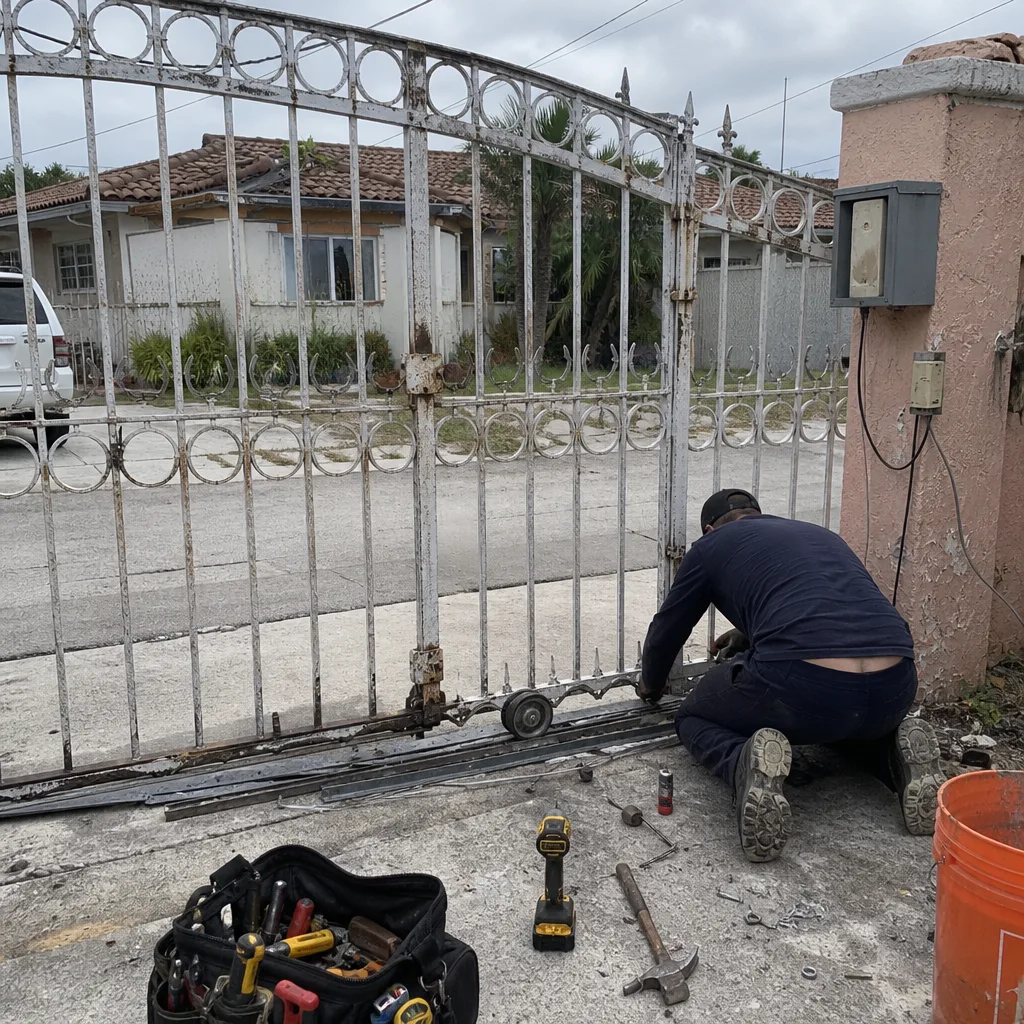 Before
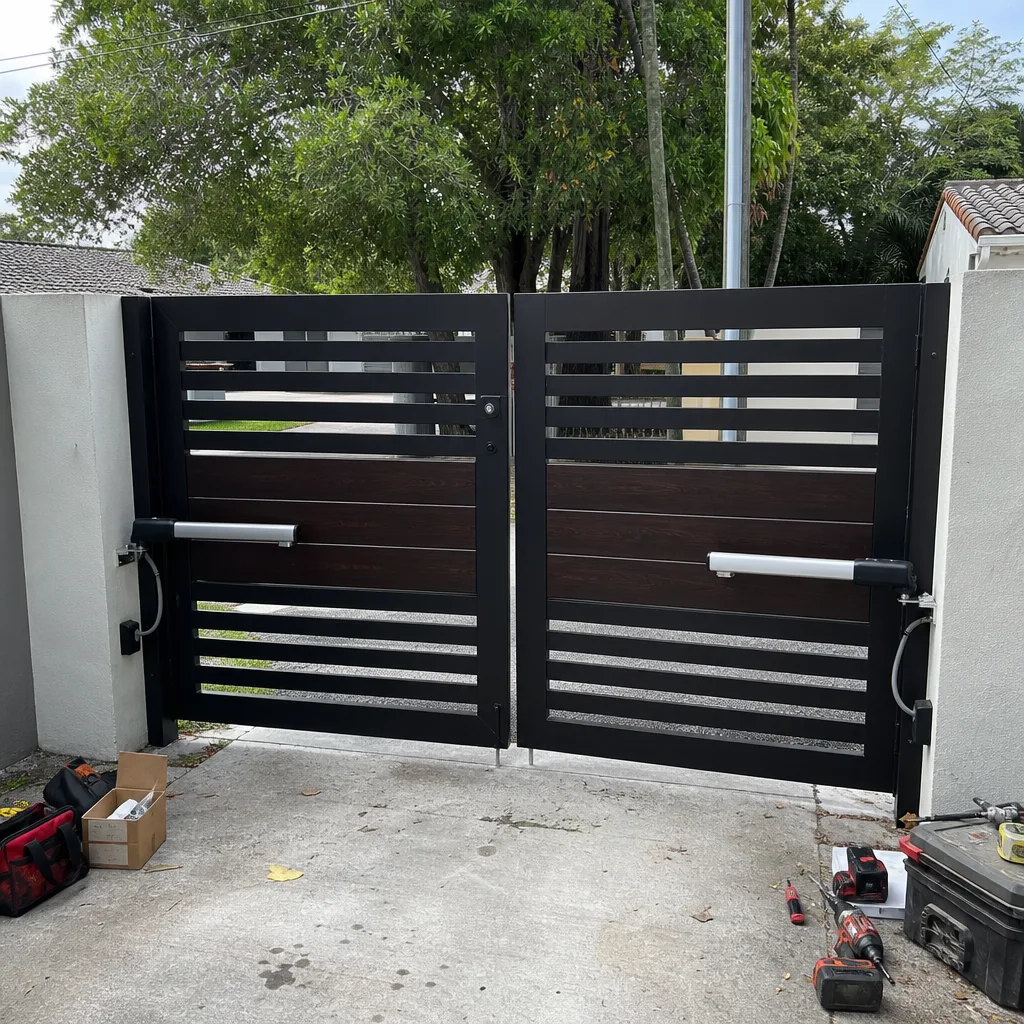 After
After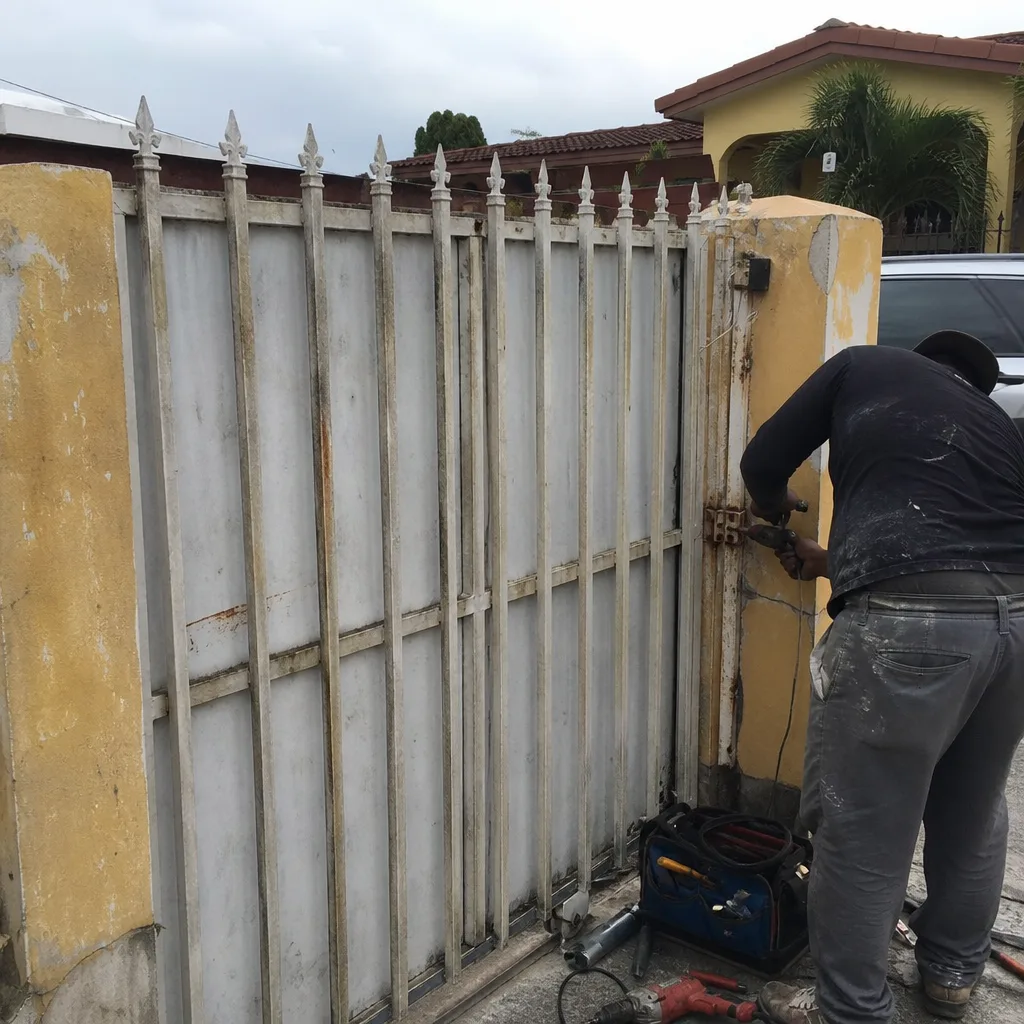 Before
 After
AfterSeasonal Gate Repair Care for Miami Gardens: Year-Round Homeowner’s Guide
Miami Gardens gates don’t rust in winter. They rust in September, two weeks after the last named storm pushed salt spray inland, and nobody checked. The city’s 60-plus inches of annual rain, combined with salt air carried miles from the coast and a water table that sits close to the surface, creates a corrosion and wear pattern that follows a calendar as reliably as snow follows winter up north. Most gate failures here aren’t random. They’re seasonal. And once you know which failure follows which month, you can prevent most of them before a motor burns out, a hinge shears, or a security gate leaves your property open overnight. This guide maps the maintenance calendar that matches how Miami Gardens weather actually behaves, month by month and storm by storm. For hands-on help, our Gate Repair team handles everything from corrosion fixes to full motor replacements.
Quick Answer
Seasonal gate care in Miami Gardens means following a three-part calendar: pre-hurricane preparation in May and June, post-storm corrosion assessment between September and November, and a dry-season electrical inspection between December and March when lower humidity causes metal expansion gaps that shift limit switches. A homeowner who does fifteen minutes of documented inspection each season, plus one annual professional service call, will prevent most gate motor burnouts, hinge failures, and control board replacements that our technicians see every week. For more guides & resources on keeping your gate running, explore our blog. The cost of this pattern runs a fraction of a single emergency gate motor replacement, and the photo record you build makes any future repair faster and cheaper to diagnose.
Table of Contents
- The Real Gate Failure Calendar in Miami Gardens
- Pre-Hurricane Season Gate Checklist: What to Tighten, Back Up, and Document
- Post-Storm Assessment Protocol: The Order That Finds Hidden Damage
- Why Dry Season Causes Limit Switch Drift (and Motor Burnout)
- Rainy Season Drainage: Standing Water and the One-Year Corrosion Timeline
- Annual Photography Standard: What to Shoot, What Angle, What Lighting
- Month-by-Month Gate Care Calendar for Miami Gardens
- Common Mistakes to Avoid
 Before
 After
AfterThe Real Gate Failure Calendar in Miami Gardens
Every city with gates has a failure pattern. In Phoenix, it’s hardened rubber and cracked plastic from 110-degree heat. In Minneapolis, it’s frozen gearboxes and snapped chains. In Miami Gardens, it’s a three-part sequence: salt-laden humidity from May through October, standing water from daily summer thunderstorms, and a dry-air period from December through March that shrinks metal just enough to change gap tolerances that were set during the wet season. Each phase produces a different class of failure, and each failure looks different on the workbench.
We’ve repaired over 22,000 gates since 2014, and the pattern holds. The calls we receive in August are not the same as the calls we receive in January. August brings control boards shorted by water intrusion and photo-eyes clouded by mineral deposits from evaporated rain. January brings limit switch faults, gear slippage, and motors that run three seconds past their travel stop because the gate’s geometry changed by a few millimeters when the air dried out. The owner who understands this calendar can inspect for the right problem in the right month instead of discovering it after the gate stops working.
Miami Gardens sits on a high water table in many neighborhoods. Add 60 inches of rain concentrated in six months, and the ground around gate posts never truly dries. The bottom six inches of a steel gate post live in a microclimate that alternates between saturated and merely damp. That’s where the corrosion timeline starts, and it’s the reason a gate that looked fine in April can show rust bloom at the base by November. This isn’t a defect. It’s geography. And geography responds to a schedule.
For homeowners reading this who have never had a gate professional out, the starting point is a full inspection from our Gate Repair in Miami Gardens team. We photograph everything, hand you the record, and price any repairs in writing before work begins. That baseline makes every seasonal check after it faster.
Pre-Hurricane Season Gate Checklist: What to Tighten, Back Up, and Document
Hurricane season starts June 1, but the wind arrives earlier than the storm. Any day in May with a passing front can generate gusts strong enough to rattle a gate against its stops. A gate that isn’t tight in May is a gate that damages itself in August. The pre-hurricane check has three goals: tighten everything that can loosen, back up every setting that can be lost, and photograph everything so an insurance claim has a dated baseline.
Step 1: Tighten Every Load-Bearing Fastener
Walk the gate with a wrench and a socket set. Two things matter most:
- Hinge bolts on swing gates: The bottom hinge takes the most punishment, especially on a gate that drags slightly or sits out of plumb. If the gate post shifts even an eighth of an inch during a storm, loose hinge bolts turn that shift into a sheared weld. Tighten them now, and mark the bolt head with a paint pen so you can see at a glance next season whether anything moved.
- Track and roller adjustments on slide gates: A slide gate that rattles in its track during normal wind already has slack. That slack becomes impact force when a hurricane gust hits. The rollers should make contact with the track without leaving daylight between the wheel and the rail. If you can wiggle the gate side to side by hand, the rollers need adjustment before the season starts.
Step 2: Back Up Your Electrical Settings
Modern gate motors from brands like BFT, Linear, and Viking store their travel limits and force settings on a control board. If a power surge or water intrusion wipes that board, the replacement board needs to be programmed from scratch, and without a record, the technician estimates what the settings were. An estimate is slower than a measurement, and on a gate that’s been in place for years, it’s rarely exact.
Take two photos of the control board with your phone. First, a wide shot showing every DIP switch, dial, and terminal block with the board cover off. Second, a close shot of any digital display or LED indicators. Store those photos in a folder labeled with the date and the word “gate.” If the board dies in September, the tech who arrives will have the original configuration in your phone, and programming takes minutes instead of a guess-and-check session.
Step 3: Document the Gate’s Condition With Dated Photos
Insurance adjusters work from evidence. If a storm bends a gate leaf or rips a motor free, the claim moves faster when you can show what the gate looked like before the storm. Shoot four angles: wide front, wide back, close-up of each hinge or roller assembly, and close-up of the motor and control board. The date stamp on the photo is the document. This same set of photos is what our Gate Motor & Opener in Miami Gardens team uses as a baseline when we arrive for a diagnostic call.
Step 4: Test the Manual Release
A power outage during or after a storm means the motor won’t open the gate. If you don’t know where the manual release is, or it’s rusted shut, you’re either stuck outside your own driveway or trapped inside it. Find the release mechanism. Many swing gate motors from Ghost Controls and Viking have a pull handle or a keyed release. Slide gates typically have a lever on the motor housing. Test it now, with the power on, so you know exactly how it moves and how much force it takes. A little effort in May beats a dark driveway in September.
Post-Storm Assessment Protocol: The Order That Finds Hidden Damage
The mistake most homeowners make after a named storm is checking only the obvious: did the gate open, did the motor run, did anything fall off. A gate can pass all three checks and still be carrying damage that will fail six months later, usually at the worst possible time. The post-storm inspection follows a specific order because each layer of the system protects the one below it. Inspect from structure to electrical, and you’ll find the problem while it’s cheap to fix.
Step 1: Structural Check
Stand at the gate and look at its silhouette against the sky. A gate that was square before the storm should be square after it. Look for a leaf that sags, a post that leans, or a gap at the top of the gate that’s wider than the gap at the bottom. Any of these means the post shifted or the hinge assembly took a hit. A sagging gate puts a side load on the motor every time it cycles, and that side load is the leading cause of premature gearbox wear in swing gate motors. If you see a change, mark the gate’s resting position with tape on the post, take a photo, and have a professional look before the next wet season.
Step 2: Track and Roller Check (Slide Gates)
Debris from the storm ends up in the track. Sand, leaves, small branches, and sometimes pieces of your neighbor’s fence. Run the gate and listen. A grinding sound under the gate means something is trapped between the roller and the rail. A gate that shudders on startup means the track is binding. Clear the debris you can see, then run the gate again with your hand resting lightly on the gate leaf. Vibration you can feel through the metal is a sign that something is still in the track or a roller bearing took damage during the storm.
Step 3: Electrical Check
Open the control board cover and look for three things: water marks, corrosion on terminals, and insects. Miami Gardens ants love control boards. They build nests in the warm enclosure, and their bodies short out low-voltage circuits. If you see a line of ants marching along the board’s edge, power the gate down at the breaker and blow the enclosure out with compressed air before the nest grows. Any sign of rust on a terminal or a white crust on a wire connection means moisture got in during the storm, and that connection will fail. It’s not a matter of if.
Step 4: Photo-Eye and Safety Loop Check
The photo-eye (the infrared beam that stops the gate if something crosses the path) was misaligned by wind or debris in more storms than we can count. Test it: with the gate open, hold your hand in front of one eye and press the remote to close. If the gate doesn’t stop, the photo-eye is misaligned, dirty, or dead. Clean both lenses with a dry cloth, and if the gate still doesn’t stop, call a technician. A gate that closes through an obstruction is a different kind of storm damage, and it’s the one that hurts someone.
After any named storm, a professional post-storm inspection catches what a visual check misses. Vance Gate Repair Miami Gardens performs these inspections with a written report: what was found, what was adjusted, what was replaced, and photos of each. Call (786) 789-0087 to schedule one.
Why Dry Season Causes Limit Switch Drift (and Motor Burnout)
Miami Gardens dries out between December and March. Humidity drops from the 80s to the 50s, the afternoon thunderstorms stop, and the metal in every gate and post contracts slightly as it loses moisture from the air around it. That contraction is small, measured in fractions of an inch, but it’s enough to change the geometry of a gate that was set up during the wet season. The result is the most common dry-season failure we see: limit switch drift.
A limit switch is the sensor that tells the motor when the gate has reached the end of its travel. When a swing gate opens, the motor runs until the limit switch trips and cuts power. Same on close. If the gate leaf contracts by a quarter inch, the limit switch now trips a quarter inch early or late, and the motor either stalls against a stop that’s slightly out of position or coasts past where it should stop. Neither feels like a problem at first. The gate opens. The gate closes. But over weeks, the motor is running a little longer or pushing a little harder than it was designed to, and that extra work shows up as heat.
Heat is what kills a gate motor. The windings in the motor are insulated with varnish, and that varnish degrades with sustained heat. A motor that runs 100 cycles a day with a slightly misaligned limit switch runs hot on every cycle. Three months later, the varnish cracks, the windings short, and the motor is dead. The gate didn’t break suddenly. It was slowly cooked by a limit switch that drifted out of calibration in December.
How to detect it before the burnout: listen. A gate motor that’s fighting a stop makes a slight groan or a change in pitch just before it shuts off. It sounds like a motor working, but the tone is strained, like a car engine running just above idle when it should be coasting. The second sign is temperature. After ten open-close cycles, the motor housing should be warm, not hot. If you can’t keep your palm on the motor for five seconds, the limit switch needs attention, and soon.
Here’s the order we recommend for Miami Gardens homeowners in December:
- Run the gate through ten full open-close cycles and listen for a change in motor pitch at the end of each travel.
- Check the gate’s resting position in both the open and closed state. Does it sit flush against its stop, or does it look slightly short of or past the stop?
- Feel the motor housing after the cycles. Warm is normal; hot is a warning sign.
- If anything feels off, call a technician before the motor burns out. A limit switch adjustment on a Linear or BFT motor is a fraction of the cost of a full motor replacement.
This is where our documentation habit pays off. When a Vance Gate Repair Miami Gardens technician sets a limit switch, the position is photographed and the setting is written into the service record. Next year, the next technician compares the current reading to the recorded one and sees exactly how far it drifted. No guesswork, no re-diagnosis, no second charge for the same discovery. That’s the point of the written record, and it’s the same habit Adrian Vance started on commercial access-control sites in 2014.
Rainy Season Drainage: Standing Water and the One-Year Corrosion Timeline
Miami Gardens rain doesn’t fall evenly. It arrives in the afternoon, hard, for twenty minutes, and then stops. The ground drinks what it can, and the rest pools. If your gate post sits in a low spot, or the gate’s base collects water that doesn’t drain, that standing water begins a corrosion timeline that runs quietly for a year before it shows up as a failed component.
The corrosion isn’t instant. It’s a sequence. Week one: water sits at the gate base and begins to wick into the powder coat or paint at any small scratch. Month two: the metal underneath starts to rust, but the paint still looks intact from the outside, because the rust is growing underneath the coating. Month six: the rust reaches a fastener, a hinge pin, or a weld, and starts to expand. Rust occupies more volume than steel, so the expansion pushes the coating off in flakes. Month twelve: the hinge pin is seized, the weld is compromised, or the bottom rail has a soft spot you can push through with a screwdriver. The gate looks like it rusted suddenly. In truth, it started the afternoon the water pooled and nobody noticed.
The fix is drainage, and the check is easy:
- After the next heavy afternoon rain, walk out and look at the gate base before the water evaporates. Is there standing water against the post? Is the bottom rail touching wet ground?
- If yes, cut a shallow channel with a trenching shovel from the low spot to the nearest lower ground or a drain. The goal is to move water away from the steel in under an hour after the rain stops.
- If the gate sits over concrete that slopes toward the post, the fix may be grinding a small weep channel into the concrete so water flows past the post instead of against it.
- Check the gate’s weep holes if it has them. Most tubular steel gates have small drain holes at the bottom of the frame. If they’re clogged with paint, dirt, or insect nests, water stays inside the tube and rusts it from the inside out.
We see this timeline play out in the same neighborhoods every year. A gate installed three or four years ago starts showing rust bloom at the base after a particularly wet October, and the homeowner can’t figure out why a gate that new is rusting. The answer is drainage, first and always. Before any replacement, before any repair, fix the water. Otherwise the new gate or the new hinge starts the same clock all over again. If you’re not sure whether your gate post drains properly, a Gate Installation in Miami Gardens consultation includes a site drainage review before any new gate goes in.
Annual Photography Standard: What to Shoot, What Angle, What Lighting
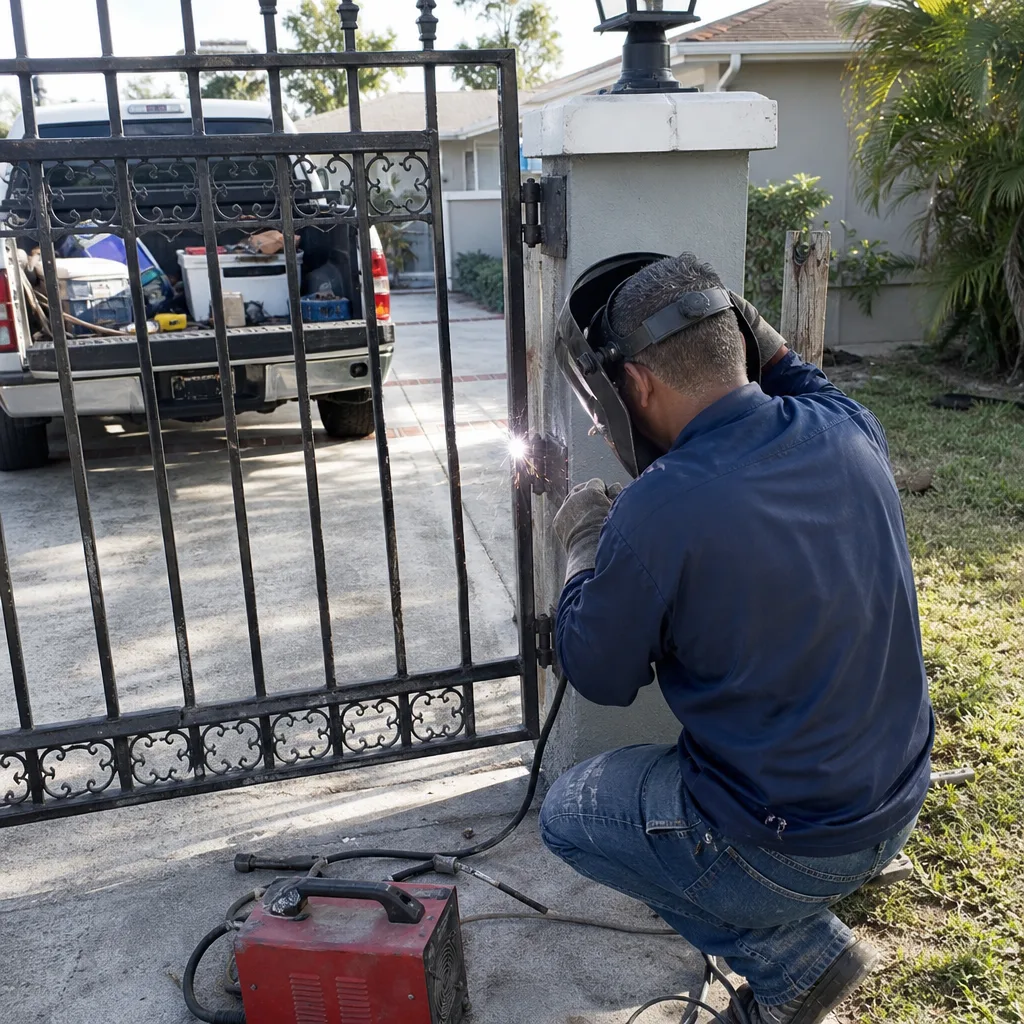
The most useful habit a Miami Gardens gate owner can build is a dated photo record taken on the same day every year. The photos don’t need to be professional. They need to be consistent. Same angles, same lighting, same time of day. The value isn’t any individual photo. It’s the comparison between years, and comparison only works when the photos line up.
What to shoot, and from where:
- The full gate from the front, standing ten feet back, gate closed. This shows the overall plumb and any sag that develops over years. Use the same distance every time. If you measure ten feet in year one, measure ten feet in year five.
- The full gate from the interior side, same distance, gate closed. This catches changes in the gate’s relationship to its stops and the ground.
- The bottom hinge or roller assembly, close-up, from six inches away. Hinge rust and roller wear show up in this angle first.
- The motor housing and control board area, cover on. This documents the motor’s condition and any water staining on the mounting surface.
- The gate’s footprint at the base, shot at ground level. This captures pooling water, rust bloom, and any contact between the gate and the ground.
Lighting matters more than framing. Shoot in the morning, between eight and ten, when the sun is low and the shadows are long. Long shadows show dents, warps, and misalignments that flat noon light washes out. Don’t shoot after rain, because wet steel hides the rust that dry steel reveals. Don’t shoot at dusk, because the warm light makes everything look better than it is and masks the oxidation color you’re trying to track.
Store the photos in a folder with the year in the name: “Gate 2024,” “Gate 2025,” and so on. When a tech asks, “When did this rust start?” you can answer with a photo from twelve months ago that shows the same spot clean. That’s the difference between a $200 repair caught early and a $2,000 replacement caught late. It’s also the same documentation standard we leave behind on every service visit: photographed evidence, a written record, and a baseline that makes the next inspection meaningful. Under Haven Standard Clause 4, every visit includes this documented photo record at no charge.
Month-by-Month Gate Care Calendar for Miami Gardens
Here’s the calendar, compressed into a single pattern. Follow it for one year and the next year runs on memory.
January to March: Dry Season Electrical Check
Run the gate ten cycles. Listen for the motor strain described above. Feel the motor housing for heat. Check the gate’s resting position against its stops. If the limit switch has drifted, call for an adjustment before the motor cooks itself. This is also the right time to check the battery backup if the motor has one, because the dry season is when batteries fail quietly and get discovered during the first summer power outage.
April to May: Pre-Hurricane Preparation
Complete the pre-hurricane checklist in this guide: tighten fasteners, mark bolt heads, back up control board settings, test the manual release, and shoot the baseline photo set. The goal is to have the gate as tight and documented as possible before June 1.
June to August: Daily Drainage Awareness
Miami Gardens afternoon thunderstorms are the main event. After any heavy rain, walk the gate base and check for standing water. Clear the track on slide gates. Wipe the photo-eye lenses if they’ve been splashed. This is also the season for ant nests in control boards, so open the enclosure once a month and evict them early.
September to November: Post-Storm Assessment and Corrosion Check
After any named storm, run the full post-storm protocol in the order it appears above. After the last storm of the season, do a complete corrosion walk: every fastener, every hinge, every weld, every inch of the bottom rail. If you find rust bloom, sand it, treat it, and repaint before the dry season sets the corrosion into the metal permanently. If you find damage beyond surface rust, get it priced in writing before it worsens.
This calendar aligns with how Miami Gardens weather actually behaves, not how a generic Florida guide describes it. The city’s combination of salt air, high water table, afternoon thunderstorms, and winter dry air creates a distinct failure pattern, and the pattern repeats every year. The homeowner who follows the calendar catches problems in their cheapest form. The homeowner who doesn’t meets the problems as emergencies, and emergency gate repair costs more, takes longer, and leaves a bigger mess. That’s not a sales pitch. That’s the difference between the invoice we write in May and the invoice we write in October.
Common Mistakes to Avoid

- Inspecting the gate only when it stops working. A gate that opens and closes quietly is a gate whose problems are still small enough to hide. By the time a symptom appears, the failure has usually been developing for months. Seasonal inspection finds it before the symptom.
- Treating all rust as cosmetic. Rust at a gate’s base or at a hinge is structural information. It’s telling you water is pooling, a coating has failed, or a fastener is dying. Painting over it without addressing the water source restarts the clock but doesn’t stop it.
- Resetting a tripped breaker without looking for the cause. A gate motor breaker that trips once is a warning. Twice is a pattern. Three times is a motor or board in distress. Resetting it and hoping is how motors die completely.
- Using WD-40 on gate hinges and rollers. WD-40 displaces water and cleans, but it doesn’t lubricate under load. It actually strips existing grease. Use a proper lithium or synthetic grease on hinges, and follow the manufacturer’s guidance on roller lubrication. The wrong product is close to no product.
- Ignoring the manual release until a power outage. When the power is out and the gate is closed, that’s the moment you discover the release is rusted or you can’t find it. Test it in daylight, with the power on, once per season.
- Photographing the gate only after a storm. Insurance claims and warranty disputes depend on a before photo. Without a dated baseline, the after photo proves nothing. Build the baseline now.
- Adjusting limit switches by feel. The limit switch position on a BFT or Linear motor matters in degrees, not inches. A quarter turn too far in either direction changes motor temperature and travel stop. If you’re not measuring, you’re guessing, and guessing on a limit switch is how motors burn out.
When to Call a Professional
Call a gate technician when the gate groans at either end of its travel, when the motor housing runs hot to the touch, when the gate sags or scrapes the ground, when the photo-eye fails the obstruction test, when the control board shows corrosion or an ant nest, or when the gate has been through a named storm and you want a documented post-storm inspection. Any one of these symptoms is a small problem in its current form and a much larger one in its next form. A professional catches the transition point and fixes it on the right side of the cost curve. Vance Gate Repair Miami Gardens offers free estimates in Miami Gardens, with a written price before any work starts and a photo record left behind when the work is done. Call (786) 789-0087 to schedule.
Frequently Asked Questions
Seasonal gate maintenance in Miami Gardens typically runs between $95 and $250 per visit depending on the gate type, the motor brand, and whether adjustments are needed. A spring tune-up that includes tightening, lubrication, limit switch verification, and photo-eye testing runs at the lower end. A post-storm assessment with corrosion treatment or limit switch recalibration runs at the higher end. Every Vance Gate Repair Miami Gardens visit includes a written price delivered before work starts, and the final invoice never exceeds the written quote. Call (786) 789-0087 for a free estimate on your gate.
Once per year, at a minimum, and twice per year if the gate is a slide gate or runs more than 20 cycles per day. The ideal schedule for most Miami Gardens homes is a professional inspection in late spring before hurricane season and a second check in early winter after the dry-season air has had a month to shift the gate’s geometry. Homes near the city’s eastern edge, where salt air carries further inland, benefit from the twice-yearly schedule regardless of usage.
You can handle the visual and manual checks: tightening hinge bolts, clearing debris from slide tracks, cleaning photo-eye lenses, photographing the gate on a schedule, and checking drainage after rain. What you shouldn’t handle yourself is anything involving limit switch adjustment, gearbox service, spring tension on slide gates, or control board wiring. Not sure whether to DIY or call a pro? Read DIY vs Professional Gate Repair: The Miami Gardens Homeowner’s Decision Guide before deciding. These components can cause serious injury or further damage when adjusted without the right tools and the right measurements. High-tension components deserve a trained professional, and the savings from doing it wrong are never worth the cost of the repair that follows.
Photo-eye misalignment is the most common, since wind flexes the mounting brackets and knocks the beam out of alignment. The second most common is water intrusion into the control board through a gasket that wasn’t seated properly after a previous service. Both are easy to fix when caught early and expensive when ignored. A post-storm inspection catches both before the next rain exposes the damage further.
Yes. We service motors from BFT, Linear, Viking, Ghost Controls, LiftMaster, FAAC, DoorKing, Elite, and Mighty Mule. We don’t steer you toward a replacement motor just because we prefer one brand. We diagnose the motor that’s already on the property and repair it when repair is the right call. The written record from every visit includes the motor brand, the settings we adjusted, and the parts we installed, so any future technician has the full history.
A swing gate motor replacement in Miami Gardens typically runs between $650 and $1,200 depending on the brand, the gate’s weight, and whether the arm bracket is intact. A slide gate motor runs higher, typically $900 to $1,800, due to the additional hardware and setup involved. These are written-price jobs: the exact quote is delivered before work starts and includes the motor, the labor, the setup, and the photo record. Call (786) 789-0087 for a free estimate on your specific gate.
The Bottom Line
Miami Gardens gate care follows a seasonal rhythm that most homeowners don’t know exists until a failure teaches them. The pre-hurricane tightening and documentation in spring, the post-storm structural and electrical assessment in fall, the dry-season limit switch and motor heat check in winter, and the afternoon drainage habit all summer long: that’s the full pattern. Fifteen minutes per season, plus one professional visit per year, keeps most gates running for their full service life and catches failures while they’re still cheap. The photo record is the multiplier. A gate owner with a year-over-year photo log and a service history never pays twice to diagnose the same problem. That’s the whole philosophy behind the Vance Gate Repair Miami Gardens home standard: written prices, documented evidence, and a calendar that matches how the weather actually behaves here.
Written by Adrian Vance, Owner at Vance Gate Repair Miami Gardens, serving Miami Gardens since 2014.